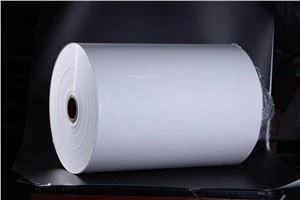
Yo! As a supplier of PP White Antistatic products, I often get asked about the Poisson's ratio of this stuff. So, let's dig into what the Poisson's ratio of PP White Antistatic is all about.
First off, what's the Poisson's ratio anyway? Well, it's a measure of how a material responds to stress. When you pull or push on a material, it doesn't just change in the direction of the force. It also changes in the perpendicular directions. The Poisson's ratio is the ratio of the transverse strain (the change in the perpendicular direction) to the axial strain (the change in the direction of the force).
For PP White Antistatic, the Poisson's ratio is an important property. It helps us understand how the material will behave under different loading conditions. For example, if you're using PP White Antistatic in a product that will be subjected to a lot of stretching or compression, knowing the Poisson's ratio can help you predict how the material will deform.
Now, the Poisson's ratio of PP White Antistatic can vary depending on a few factors. One of the main factors is the specific formulation of the material. Different manufacturers may use different additives and processing methods, which can affect the Poisson's ratio.
Typically, the Poisson's ratio of polypropylene (PP) in general ranges from about 0.35 to 0.4. But for PP White Antistatic, it might be a bit different. The antistatic additives can change the internal structure of the material, which in turn can affect its mechanical properties, including the Poisson's ratio.
Let's talk about why the Poisson's ratio matters in practical applications. Suppose you're making a container out of PP White Antistatic. When you fill the container with something heavy, the material will experience stress. If the Poisson's ratio is too high, the container might bulge out too much on the sides, which could lead to structural issues. On the other hand, if the Poisson's ratio is too low, the container might not be able to expand enough to accommodate the contents, and it could crack or break.
As a supplier, I've seen how important it is to understand the Poisson's ratio when working with customers. They often have specific requirements for their products, and the Poisson's ratio can play a crucial role in meeting those requirements.
Now, let me tell you a bit more about our PP White Antistatic products. We've spent a lot of time researching and developing our formulations to ensure that they have the right balance of properties, including the Poisson's ratio. Our products are designed to be reliable and perform well in a variety of applications.
If you're in the market for other PP - based products, we also offer some great options. Check out our PP Transparent Plastic Sheet. It's perfect for applications where you need transparency and good mechanical properties. And for food packaging, our PP Anti - fog Sheet For Food Packaging is a top - notch choice. It helps keep the food fresh and visible. Also, if you need a flame - retardant option, our PP Flame Retardant Plastic Sheet is there to provide safety.


So, if you're interested in our PP White Antistatic products or any of our other PP - based products, don't hesitate to reach out. Whether you're a small business or a large corporation, we're here to work with you. We can provide samples so you can test the products in your own applications and see how they perform. We're committed to providing high - quality products and excellent customer service.
In conclusion, the Poisson's ratio of PP White Antistatic is an important property that can affect how the material behaves in different applications. By understanding this ratio, you can make more informed decisions when choosing materials for your products. And if you're looking for a reliable supplier of PP White Antistatic and other PP products, we're here to help. Contact us to start the conversation about your procurement needs.
References:
- Textbooks on polymer science and engineering
- Industry research papers on polypropylene properties